

Bronchoscopic Management for Persistent Air Leaks
Minimally Invasive Treatment
Persistent air leak (PAL) within the lung is defined to extend beyond 5-7 days leading to prolonged chest drainage and hospital stay, and may increase morbidity.1-6
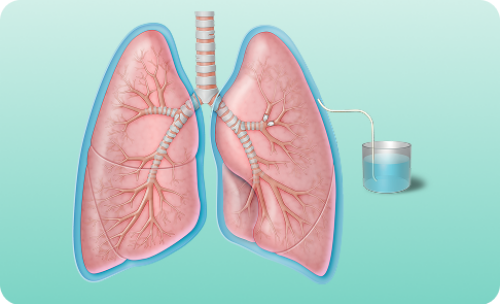
What is a Persistent Air Leak?
An air leak within the lung is defined as air escaping from the lung into the pleural cavity, resulting in a pneumothorax. It is caused by an alveolar-pleural fistula; a communication between the alveoli and the pleural space. This also can occur between a bronchus and the pleura, a broncho-pleural fistula.
How Do Zephyr Valves Treat Persistent Air Leaks?
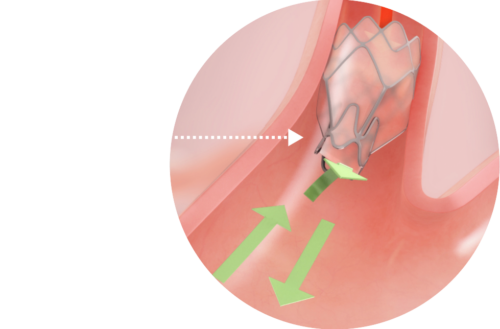
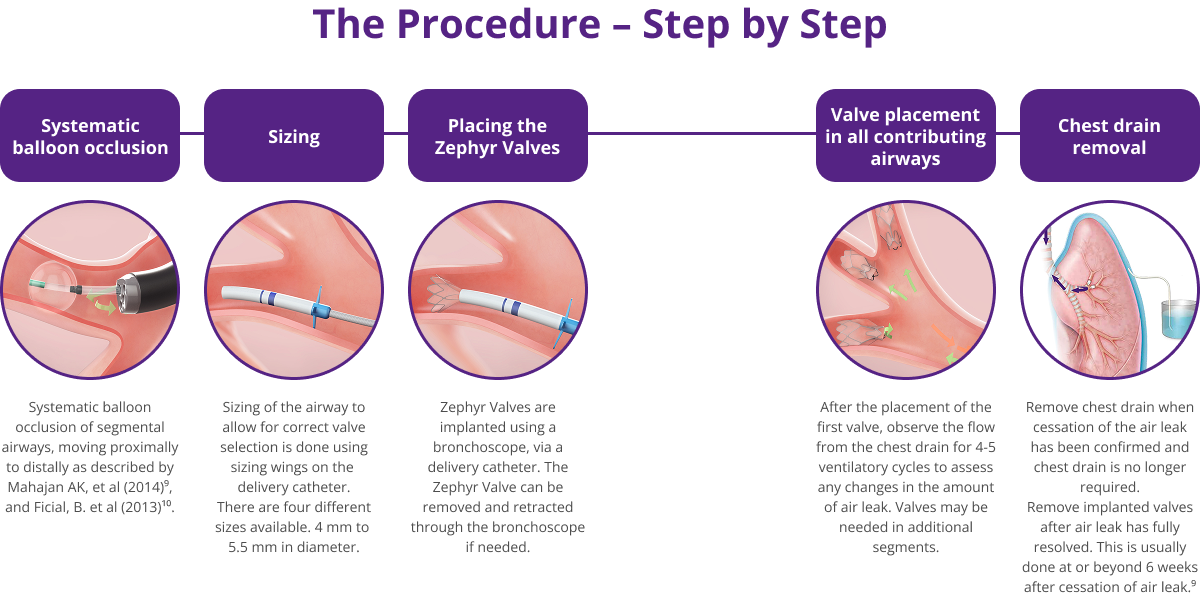
Zephyr Valves are placed via a bronchoscope under either conscious sedation or general anesthesia.8
Clinical Evidence
The success of Zephyr Valves in managing persistent air leaks has been reported in multiple case series and case reports.
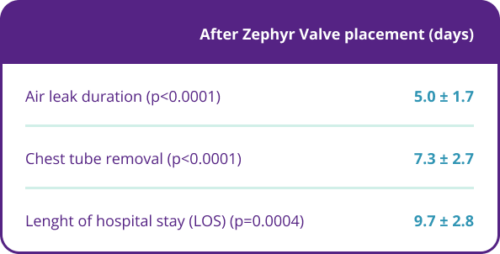
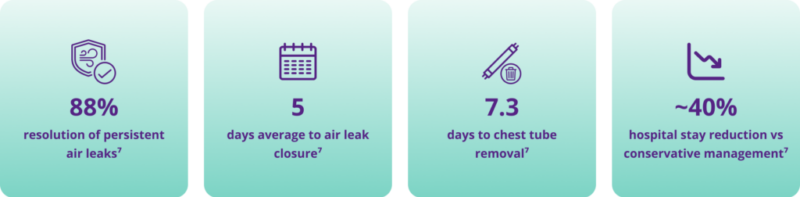
Key Outcomes
Effective Management of Persistent Air Leaks7
References
1 DuganK et al. (2017) Management of Persistent Air Leaks CHEST 2017; 152(2):417-423
2 Sirbu, H, Busch, T, Aleksic, I, Schreiner, W, Oster, O, & Dalichau, H. Bronchopleural fistula in the surgery of non-small cell lung cancer: incidence, risk factors, and management.
Ann Thorac Cardiovasc Surg, 2001; 7(6), 330–336.
3 Liang, S, et al. Quantifying the incidence and impact of postoperative prolonged alveolar air leak after pulmonary resection. J Thorac Cardiovasc Surg, 2013; 145(4), 948–954.
4 Bardell, T, & Petsikas, D. What keeps postpulmonary resection patients in hospital?. Can Respir J, 2003; 10(2), 86-89.
5 Varela, Gonzalo, et al. Estimating hospital costs attributable to prolonged air leak in pulmonary lobectomy. Eur J Cardiothorac Surg, 2005; 27(2), 329–333.
6 Irshad, Kashif, et al. Causes of increased length of hospitalization on a general thoracic surgery service: a prospective obser-vational study. Can J Surg, 2002; 45(4), 264.
7 Fiorelli A, D’Andrilli A, Cascone R, Occhiati L, Anile M, Diso D, Cassiano F, Poggi C,Ibrahim M, Cusumano G, Terminella A, Failla G, La Sala A, Bezzi M, Innocenti M, Torricelli E, Venuta F, Rendina EA, Vicidomini G, Santini M, Andreetti C. Unidi-rectional endobronchial valves for management of persistent air-leaks: results of a multicenter study. J Thorac Dis 2018;10(11):6158-6167. doi: 10.21037/ jtd.2018.10.61
8 Pulmonx Corp. Zephyr® Endobronchial Valve System Clinical Evaluation Report. Document 631-0016, Revision J. Redwood City, CA: Pulmonx Corporation; 2025; Section 3.7 (Intended Users).
9 Mahajan AK, Doeing DC, Hogarth DK. Isolation of persistent air leaks and placement of intrabronchial valves. J Thorac Cardiovasc Surg. 2013;145:626-630
10 Ficial, B.; Whebell, S.; Taylor, D.; Fernández-Garda, R.; Okiror, L.; Meadows, C.I.S. Bronchoscopic Endobronchial Valve Therapy for Persistent Air Leaks in COVID-19 Patients Requiring Veno-Venous Extracorporeal Membrane Oxygenation. J. Clin. Med. 2023, 12, 1348.
EUR-EN-2925-v1